Facebook Advertising for Painting Companies: How to Fix Rising Lead Costs in Meta's New Ad Environment

If your Facebook and Instagram ads have stopped working the way they used to, you're not imagining it. A lot of painting business owners are seeing the same thing right now: cost per lead is going up, lead quality is going down, ads that used to work are burning out faster, and booked estimates are harder to come by. And throwing more budget at the problem isn't fixing it.
The frustrating part is that nothing obvious changed. Your offer, market, budget, agency, campaign structure, and creative may all be the same. But the way Meta evaluates and delivers ads has changed, and the old Facebook advertising playbook most painting companies have been using for the last few years no longer works the way it used to.
This post breaks down what changed, why painting companies are feeling it so hard, and how to rebuild your Meta ads so you can lower lead costs, improve lead quality, and create a more predictable flow of painting leads.
The Short Version: Meta Ads Are No Longer Just About Targeting
For years, most Facebook advertising strategies were built around audience targeting. You picked an audience, stacked interests, narrowed by homeowner behavior, income range, location, and service type, then launched a few before-and-after ads and waited for leads. That worked for a while.
But Meta's system now relies much more heavily on creative signals and machine learning than manual audience targeting. In plain English, Meta is paying closer attention to the actual ad itself: the image, video, copy, format, offer, and angle. Your creative is no longer just the thing people see. It is one of the main signals Meta uses to decide who should see your ad in the first place. For painting companies, that changes everything.
Why Your Facebook Ads Stopped Working
Most painting companies did not suddenly get worse at marketing. The rules changed underneath them. The old system rewarded tight audiences, simple campaign structures, and a handful of proven ads; if you found a before-and-after ad that worked, you could run it for months.
The newer Meta environment works differently. Instead of simply delivering to the narrow audience you selected, Meta looks at your creative to determine who the ad is most relevant for. If your ads all look and sound the same, Meta has very little to work with. And if most of your creative library is similar before-and-after photos, the platform may read your account as repetitive, stale, or too narrow. That shows up as:
- Higher CPMs
- Higher cost per lead
- Lower lead quality
- Fewer booked estimates
- Faster creative fatigue
- More inconsistent lead flow
The fix is not necessarily to spend more. The fix is to give Meta better signals.
The Warning Signs Your Meta Ads Need a Reset
You may need to rethink your strategy if you're seeing any of these:
- Your CPM is climbing week over week. If cost per 1,000 impressions keeps rising without major changes to budget, offer, or market, your creative may be getting tired.
- Your CPL has doubled in the last 30 to 60 days. Cost per lead fluctuates, but a major sustained increase usually means the system is struggling to find the right people at the right price.
- Your leads feel worse. More tire-kickers, fewer serious homeowners, more form fills that never book the estimate.
- Your best ads suddenly stopped working. If a winner went from reliable to dead overnight, it may not be the offer. It may be how Meta is reading and distributing your creative.
When this happens, most contractors increase the budget, fire the agency, or turn Meta ads off completely. Sometimes those moves are necessary. But often the account doesn't need to be abandoned; it needs to be rebuilt around the way Meta works now.
The Five Facebook Advertising Myths Costing Painting Companies Money
Before you install the new playbook, you need to uninstall the old one.
Myth #1: Narrow targeting beats broad targeting
A few years ago it made sense to target homeowners in specific ZIP codes, layer on household income, and add home-improvement interests until you had the "perfect" audience. The problem is that narrow audiences can starve Meta of the signal density it needs to learn. Your best buyers don't always fit neatly into interest tags; some homeowners ready to repaint haven't engaged with home improvement content at all.
Do this instead: use broader targeting. Keep the essentials (service area, age range when relevant, and exclusions such as existing customers), then let Meta use your creative and conversion data to find the right people.
Myth #2: Six ads per ad set is the sweet spot
A small number of ads per ad set made sense when the system focused on finding one winner and pushing spend toward it. Meta's current delivery is more dynamic: it matches different creative to different people based on what each person is most likely to respond to, so it needs enough variety to work with.
Do this instead: run 12 to 25 truly different creatives per ad set; for many painting companies the sweet spot is 15 to 20 active creatives. The key phrase is truly different. Five versions of the same exterior before-and-after do not count as five concepts; different creative means different angles, formats, hooks, proof points, and messages.
Myth #3: Before-and-after ads are enough
Before-and-afters still have a place. The problem is relying on them too heavily. When 80% of your ad library is similar transformation photos, homeowners find the ads familiar and Meta doesn't get enough signal diversity.
Do this instead: pair before-and-afters with other angles: customer reviews, owner story videos, process videos, prep quality education, warranty explanations, financing messages, neighborhood-specific proof, and "signs your paint is failing" content. The goal isn't to abandon before-and-afters; it's to stop making them carry the entire account.
Myth #4: Facebook Feed alone protects lead quality
Some companies restrict placements believing Facebook Feed produces the highest-quality leads, but restricting placements can raise costs. Meta is designed to find efficient impressions across Facebook, Instagram, Stories, Reels, and Feed; limiting where ads show makes the system work harder and pay more.
Do this instead: use Advantage+ placements and let Meta decide where ads serve based on performance. A large share of impressions may naturally serve on Instagram; that doesn't automatically hurt lead quality. What matters is whether your creative, form, follow-up, and qualification process attract the right homeowners.
Myth #5: Manual bid caps protect your ROAS
Bid caps can be useful in mature accounts with enough conversion data, but used too early they choke the system. If the cap is too restrictive, Meta may avoid higher-value impressions that could have produced better leads and better jobs.
Do this instead: start with lowest-cost bidding and let the system gather data. Only consider cost caps after you have at least 50+ conversion events to make that decision intelligently.
The New Facebook Advertising Playbook for Painting Companies
The new playbook isn't more complicated; in many ways it's simpler. Instead of trying to outsmart Meta with tiny audiences and complicated structures, your job is to give the system strong creative variety, clean conversion signals, simple campaign architecture, enough data to learn, and a consistent refresh cadence. Five pillars:
Pillar #1: Creative diversity
Creative diversity is the biggest lever in modern Facebook advertising. Meta needs different kinds of ads to match different kinds of buyers: some homeowners respond to pain, some to proof, some to process, some to financing, some to the owner's story, and some need to see that neighbors trust you. A healthy ad account isn't built on one message; it's built on a creative library.
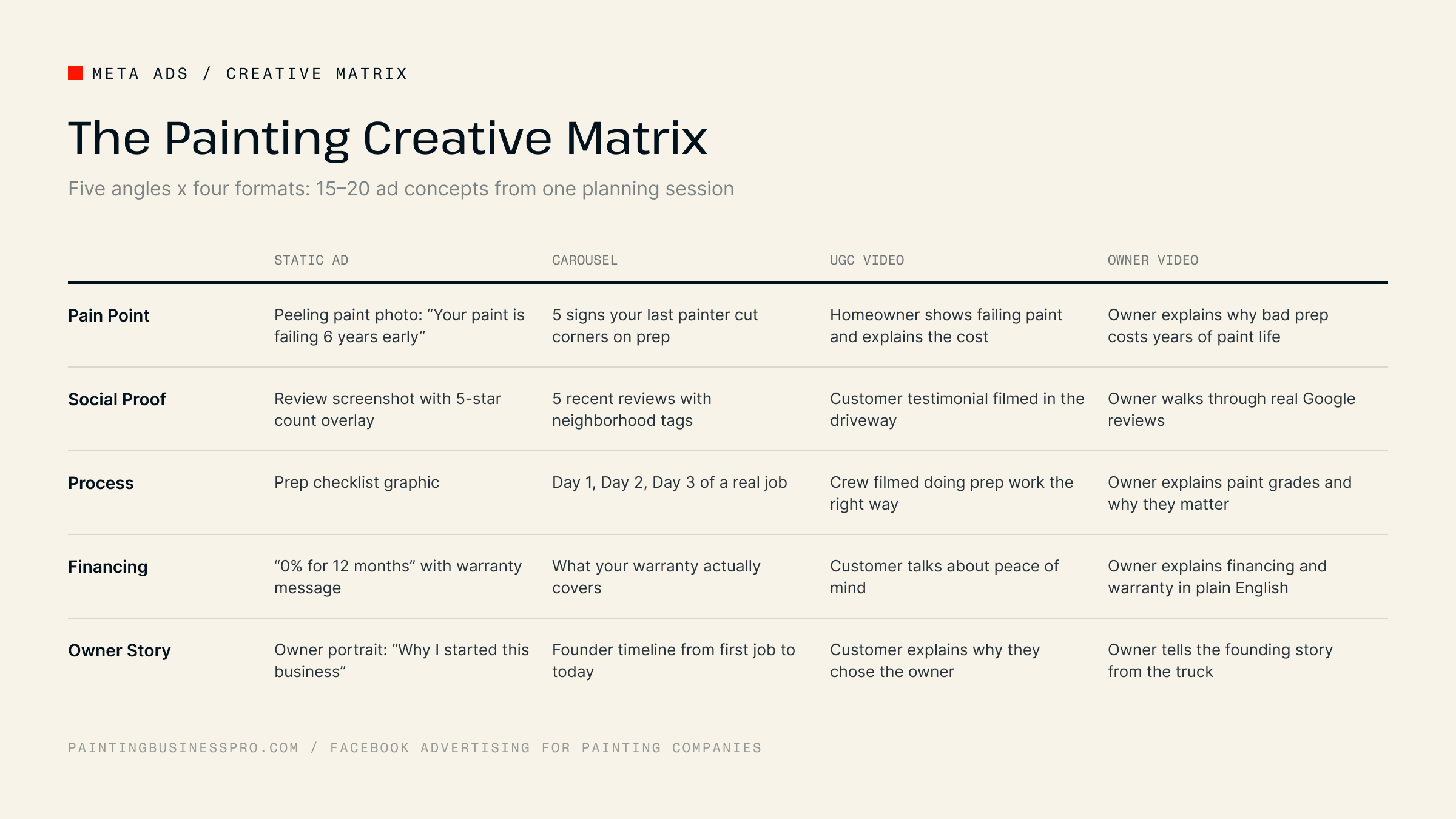
A simple test: describe two ads in one sentence each. "A before-and-after photo of a blue house" and "another before-and-after photo of a blue house" are not meaningfully different. "A homeowner testimonial filmed in the driveway," "a carousel showing five signs your exterior paint is failing," "an owner video explaining why bad prep makes paint fail early," and "a static ad promoting 0% financing and a 10-year warranty" are. Use the Painting Creative Matrix above: pick multiple angles (pain point, social proof, process, financing, owner story) and multiple formats (static, carousel, UGC video, owner video) to generate 15 to 20 concepts from one planning session.
Pillar #2: Campaign simplification
Many accounts are overbuilt: separate campaigns for interior and exterior, ad sets split by audience, budgets split by service, manual placements, narrow interest stacks. The intention is control, but too much structure slows learning and splits budget into pieces too small to optimize. Start with one campaign, one ad set, broad targeting, and put your creative in a shared ad set so every concept gets a fair shot at delivery.
Pillar #3: Signal strength
Most contractors optimize for form fills. A form fill doesn't tell Meta whether the person booked, answered the phone, became a customer, or whether the job was worth $1,200 or $12,000. If all Meta sees is "lead submitted," it finds more people who submit forms, which can raise volume while lowering quality. Strengthen your signals: Meta Pixel installed correctly, Conversions API connected, lead events tracked, booked estimate events tracked when possible, won job and customer data uploaded offline, and CRM data connected consistently. The more quality data you send back, the better Meta gets at finding people who actually book and buy.
Pillar #4: Creative refresh cadence
Creative burns out faster than it used to. By the time your CPL doubles, fatigue has been building for weeks; CPM is usually the earlier warning sign. Refresh creative every one to two weeks. That doesn't mean weekly production shoots: build new ads from customer review screenshots, jobsite photos, short phone videos, owner selfie videos, crew process clips, neighborhood-specific projects, sales call FAQs, warranty explanations, and financing messages. And pause tired creative instead of deleting it; pausing preserves account history.
Pillar #5: Better measurement
CTR, frequency, and short-term ROAS don't tell the whole story in a service business with a longer sales cycle. The better question isn't "did this ad get cheap clicks?" but "did this ad get more qualified homeowners at a cost that makes sense?" Watch CPM trend week over week, cost per quality lead, booked estimate rate, close rate, cost per booked estimate, cost per sold job, creative fatigue by angle, performance by format, and lead source to revenue. CPL matters, but CPL alone can lie: a $40 lead that never books is more expensive than a $95 lead that turns into a $6,000 job.
The 72-Hour Meta Ads Recovery Plan
You don't need to rebuild your entire marketing strategy. You need to clean up the account, refresh the creative, and give Meta stronger signals. A simple three-day reset:
Day 1: Audit and consolidate (90 minutes)
Open your current campaign structure and identify the campaign that has historically produced the best lead quality, not just the cheapest leads. Then consolidate into one campaign and one ad set with broad targeting; keep geography and basic exclusions; exclude active customers when appropriate; turn on Advantage+ placements; pause duplicate or fragmented campaigns; and remove unnecessary audience restrictions. The goal is one clean structure with enough budget and data to learn.
Day 2: Produce new creative (3–4 hours or one shoot day)
Pick at least four angles and three formats from the matrix: a pain point static ad, social proof carousel, process UGC video, owner story video, financing static ad, warranty carousel, review screenshot ad, crew prep video. Aim for 8 to 12 new creatives minimum. No shoot capacity? Use what you have: customer texts, Google reviews, before-and-after photos, jobsite photos, phone videos, owner selfie videos, CRM screenshots, sales call questions, warranty and financing details. Your phone is enough to start. The goal isn't Hollywood production; it's signal diversity.
Day 3: Launch and monitor
Upload the new creatives into the consolidated ad set, then give the system time to relearn. At 24 hours, check CPM; in a healthy reset it should stabilize or trend down. At 72 hours, check CPL for direction. Over the next week, watch CPM, CPL, lead quality, booked estimate rate, which angles get delivery, which formats produce better leads, and which ads attract tire-kickers. Then keep refreshing. This is not a one-time fix; it's a new operating rhythm.
What "Fixed" Looks Like
Your Meta ads are moving in the right direction when CPM is stable or slowly declining, CPL is trending back toward your historical baseline, lead quality and booked estimate rate are improving, your creative library is refreshed every two weeks, Pixel and CAPI events are flowing, offline conversion data is being uploaded, and your account has one campaign, one ad set, and 15+ active creatives. The goal is not just cheaper leads; it's a predictable lead system. Cheap leads don't matter if they never turn into booked estimates, sold jobs, and actual revenue.
FAQs About Facebook Advertising for Painting Companies
Are Facebook ads still worth it for painting companies?
Yes, Facebook ads can still work very well, but the strategy has changed. The old approach of narrow targeting, a few before-and-after ads, and manual placement control is less reliable than it used to be. Today painting companies need broader targeting, stronger creative variety, better conversion tracking, and a consistent refresh cadence.
Why did my Meta ads suddenly stop working?
The platform now relies more heavily on creative signals and machine learning. If your campaign structure is fragmented or your ads are too similar, Meta may struggle to find the right buyers at the right cost. Rising CPM, rising CPL, and lower lead quality are the common warning signs.
How many Facebook ads should a painting company run?
Aim for 12 to 25 active creatives per ad set, with many accounts performing best around 15 to 20. The ads should be meaningfully different, not small variations of the same before-and-after image.
What kind of Facebook ads work best for painters?
Before-and-after ads can still work, but as part of a larger mix. Strong angles include customer reviews, process videos, prep education, warranty explanations, financing offers, owner story videos, neighborhood proof, and pain-point messaging around peeling, fading, or failing paint.
Should painting companies use broad targeting on Meta?
In most cases, yes. Broad targeting gives Meta room to learn and find qualified buyers. Focus targeting on geography, age when relevant, and key exclusions such as existing customers. Overly narrow interest targeting can limit delivery and increase costs.
Should I use Advantage+ placements for my painting ads?
Usually, yes. Advantage+ placements let Meta serve your ads where it finds the best opportunities across Facebook, Instagram, Reels, and Stories. Restricting placements can increase costs and reduce delivery opportunities.
How often should I refresh my Facebook ads?
Every one to two weeks. That doesn't always mean filming new professional videos; refresh with customer reviews, jobsite photos, owner videos, process clips, warranty messages, financing angles, and neighborhood-specific proof.
What is a good cost per lead for painting companies?
It depends on your market, service area, offer, seasonality, and average job value. More importantly, look beyond CPL to cost per quality lead, cost per booked estimate, and cost per sold job. A more expensive lead can be better if it books, closes, and produces a profitable project.
Final Takeaway: Stop Fighting the Algorithm. Feed It Better Signals.
If your Facebook advertising performance has dropped, it doesn't automatically mean Meta is broken. It usually means your account is still built for the old system. The new system needs broader targeting, more creative diversity, cleaner conversion signals, and simpler campaign architecture. Start with one campaign, one ad set, broad targeting, Advantage+ placements, stronger tracking, and 15+ truly different creatives. Then refresh consistently. That's how painting companies lower lead costs, improve lead quality, and build a Meta ads system that works with the platform instead of fighting against it.
Want a Second Set of Eyes on Your Meta Ads?
If your cost per lead has climbed, your lead quality has dropped, or your best ads suddenly stopped working, we can help you find the problem. Book a free 15-minute Meta ads audit with a Painting Business Pro coach. We'll review your current setup, identify what is likely costing you money, and show you where to focus first so you can start building a more predictable lead flow.