Facebook Advertising for Painting Companies: A Simple Meta Ads Guide

Facebook advertising is one of the fastest and most reliable ways for painting companies to generate high-quality leads. However, it can also become a significant source of frustration for business owners. It is common to experience a week where your advertisements perform exceptionally well, leads flow in, and estimates fill your calendar, only to watch your cost per lead spike the following week as lead quality plummets. When Meta suddenly begins spending your budget on placements that do not yield results, it is easy to feel overwhelmed while staring at Meta Ads Manager.
The reality is that Facebook advertising for painting companies has evolved substantially over the last few years. Many contractors fail because they rely on an outdated marketing playbook built around hyper-narrow audience targeting, basic before-and-after photos, and fragmented campaign structures that no longer work.
This guide serves as an educational foundation to help you build a modern, scalable lead generation system. You will learn how the Meta algorithm operates today, how to structure your campaigns for maximum efficiency, what types of creative assets you need to deploy, and how to improve your overall painting company lead generation without sacrificing volume.
What Has Changed With Meta Ads for Painting Companies?
Before you dive into technical campaign setups, you must understand a fundamental shift in how the Meta platform delivers advertisements to homeowners.
In older versions of Facebook ads for painting contractors, the platform relied almost entirely on the audience parameters you manually selected. You defined a strict demographic box, and Facebook showed your ads exclusively to individuals within those boundaries.
Today, Meta uses advanced artificial intelligence to read your creative assets. The algorithm analyzes your images, videos, ad copy, headlines, hooks, and offers, and then uses those behavioral signals to determine who should see your advertising.
The modern rule of Meta ads: your creative is no longer just what the homeowner sees. Your creative is actually your primary targeting tool.
For entrepreneurs learning how to run Facebook ads for painters, the practical takeaway is clear. You must spend less energy trying to hack audience interest settings and focus more energy on producing diverse, high-quality creative formats. Because your creative dictates who sees your ads, relying on a single before-and-after photo is no longer sufficient. You need multiple angles, formats, and messages so the AI has enough data to find qualified property owners in your local market. If your existing account has already stalled out, our guide to fixing rising lead costs in Meta's new ad environment walks through the full recovery playbook.
How Meta Ads Are Structured
Every Meta advertisement account is built using a strict hierarchy consisting of three distinct layers: campaigns, ad sets, and ads. You must construct your marketing strategy from the top down to prevent your budget from fragmenting.
1. The campaign level (the goal)
The campaign is the highest level of your account structure where you choose your primary objective. This objective tells Meta exactly what action you want a user to take. For painting companies, your primary objective should almost always be Leads. This tells the system to optimize for homeowners who will actively raise their hands to request an estimate.
The campaign level is not where you select your geographic location, set your daily budget, or upload your images. It serves purely as the container for your overarching business goal.
2. The ad set level (audience, budget, and placements)
The ad set lives directly inside your campaign and functions as the engine room of your setup. This is where you establish the technical operational parameters for your ads, including:
- Geographic service locations (such as a 50-mile radius around your city)
- Age and gender demographics (such as homeowners aged 30 to 65+)
- Daily or lifetime budget limits
- Ad placements across the Meta network
- The specific optimization event (such as instant form completion)
A reliable rule of thumb for local service businesses is that one ad set should equal one distinct audience or one unique conversion path.
3. The ad level (the creative content)
The ad is the final, bottom layer of the hierarchy and represents the only portion of your account that a consumer actually interacts with on their feed. Your ads contain your primary text copy, headlines, description text, call-to-action buttons, destination links, and media assets like photos or videos.
When you launch multiple ads inside a single ad set, Meta will naturally shift a larger portion of your budget toward the creative variants it deems most likely to convert. Do not worry if one or two ads receive the majority of your daily spend while others receive very little. This is a sign that the algorithm is optimizing your budget effectively based on real-time consumer interactions.
When Should You Create a New Campaign vs. a New Ad Set?
Cluttered, over-complicated ad accounts are one of the leading causes of wasted ad spend in the painting industry. To maintain a clean account, follow this simple operational rule: create a new campaign when your ultimate business goal changes, and create a new ad set when your audience, location, or conversion path changes.
Create a new campaign when your goal changes
You should only build a new campaign when you are asking Meta to achieve a completely different business outcome. Examples include switching objectives from direct lead generation to top-of-funnel video views, running a dedicated short-term seasonal promotion that requires an independent budget, or separating cold prospecting from a dedicated retargeting funnel.
Create a new ad set when your targeting changes
You should create a new ad set within an existing campaign when your ultimate goal remains the same, but you need to alter how or where you are reaching people. Examples include testing two separate geographic territories (such as Kansas City versus St. Louis), comparing the performance of Meta Instant Forms against your website landing page forms, or allocating distinct, controlled budgets to different service lines or cities.
The Best Campaign Structure for Meta Advertising for Painters
Most painting companies perform best with a highly consolidated account structure. Instead of building separate campaigns for interior painting, exterior painting, cabinet refinishing, and deck staining, you should leverage a single campaign optimized for data aggregation.
The recommended baseline account structure:
- Campaign objective: Leads
- Ad set targeting: broad geography (50-mile radius around your central market), age range 30 to 65+, with all detailed interest targeting left blank
- Placements: Advantage+ placements, enabled so Meta can find the cheapest high-quality views across all feeds and reels
- Ad creative: five or more distinct creative variations running concurrently within the same ad set
When you fragment your budget across dozens of small campaigns and hyper-targeted ad sets, you inadvertently starve the Meta algorithm. The AI requires a steady stream of conversion data to learn who your ideal customer is. Consolidating your budget into one broad ad set gives the platform the statistical volume it needs to optimize efficiently.
6 High-Converting Creative Ideas for Painters
Because creative copy and imagery dictate your targeting success, you need to introduce multiple angles into your ad set. Different homeowners respond to different psychological triggers. A consumer worried about property damage will respond to a video detailing your preparation process, while a busy professional will respond to a collection of five-star reviews.
1. The owner story ad
Trust is the most critical factor when hiring a home service provider. An owner story ad features a short video explaining who you are, why you started the business, and the core values of your company. A strong hook for this ad might be: "I started this painting company because I was tired of watching local homeowners pay hard-earned money for sloppy, rushed paint jobs."
2. The contextual before-and-after ad
Transformation imagery is highly effective, but you must look beyond basic side-by-side photos. Pair your transformation imagery with text that explains the technical challenge you solved, such as: "This exterior wood siding was fading, peeling, and failing prematurely due to improper moisture protection. Here is how our team prepped, sealed, and protected the property for the next decade."
3. The social proof and review ad
Homeowners want reassurance that their peers have had excellent experiences with your crew. You can utilize screenshots of Google reviews, text message compliments from clients, or short video testimonials. Use headlines like: "Why over one hundred local families trusted us with their home transformations this year."
4. The educational authority ad
Educational ads establish your company as the premier expert in your market before a homeowner even contacts you for a quote. Share valuable insights, such as three critical questions to ask before hiring a painting contractor, or why cheap paint choices result in peeling doors within two years. This attracts premium clients who prioritize quality over the lowest bid.
5. The objection-handling ad
Identify the primary reasons why local homeowners hesitate to book an estimate, such as fears over mess, property damage, crew behavior, or extended timelines. Address these concerns directly in your ad copy by showcasing exactly how your crew protects flooring, landscape elements, and furniture during a project.
6. The seasonal offer ad
Direct response offers are great for filling open slots during seasonal transitions or scheduling lulls. These ads can highlight a complimentary color consultation, early-spring booking incentives, or flexible financing options. Avoid heavy discount language, as messages centered on being the cheapest option will inevitably attract low-margin price shoppers.
Step-by-Step Guide to Launching Your First Campaign
To illustrate how to execute this strategy correctly, let us walk through a practical scenario for a painting company operating in a major metropolitan area.
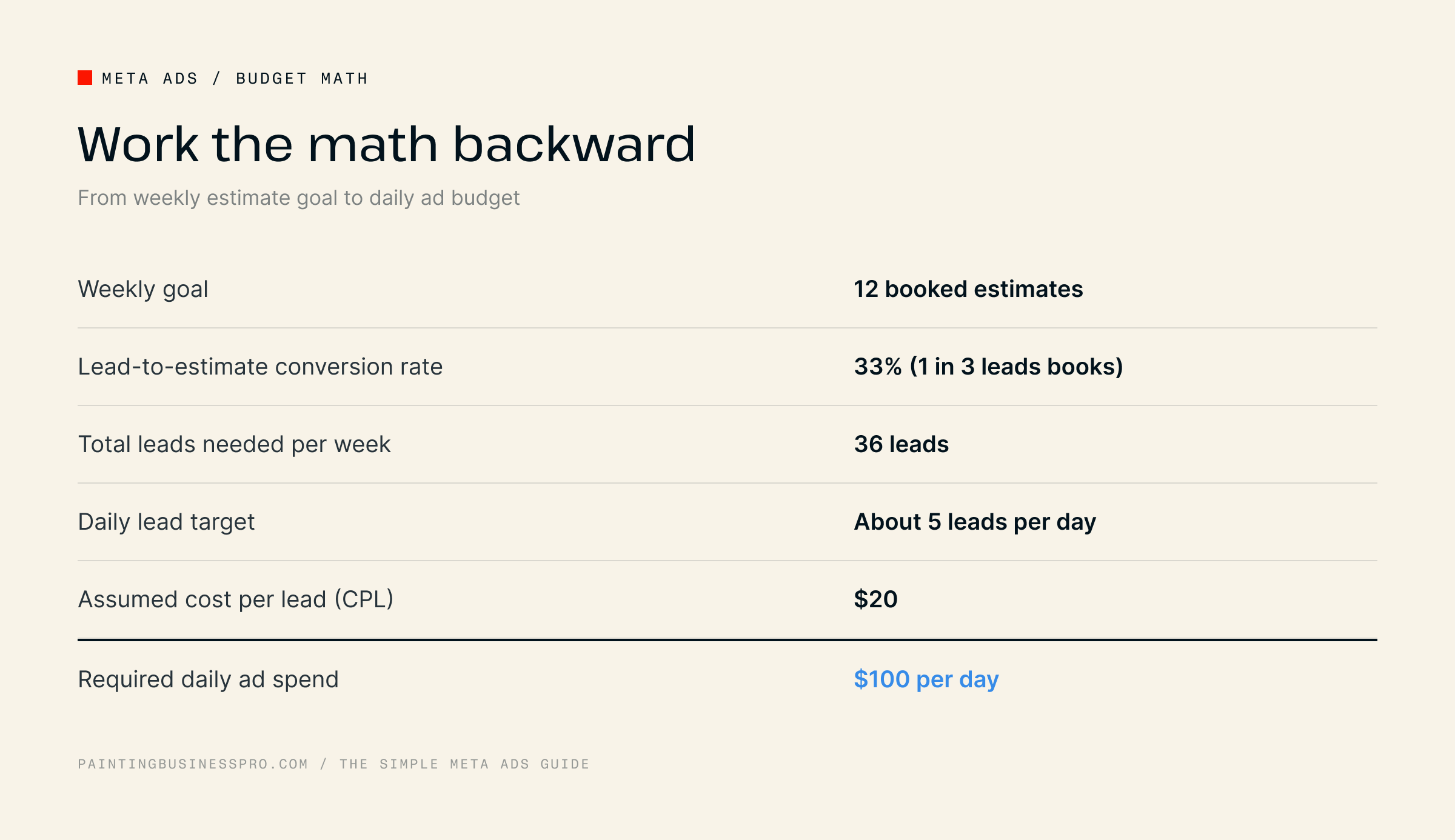
Step 1: Calculate your math backward
Do not pick an arbitrary ad budget. You must calculate your budget based on your real business metrics and revenue goals, as the table above shows. Say your weekly goal is 12 booked estimates and 1 in 3 leads books an estimate (a 33% conversion rate): you need 36 leads per week, or about 5 leads per day. At an assumed cost per lead of $20, that works out to a required daily ad spend of $100. If your cost per lead is higher or your booking rate is lower in your specific city, adjust your daily budget accordingly to match your real-world outcomes.
Step 2: Configure the campaign and ad set
Create a new campaign in Ads Manager utilizing the Leads objective. Move to the ad set level, name it according to your territory, and set your daily budget. Select your exact geographic service radius and leave all interest categories entirely blank. Ensure Advantage+ placements are toggled on so your ads can serve fluidly across Instagram, Facebook feeds, and video reels.
Step 3: Optimize your lead form settings
Select Instant Forms as your conversion location. To ensure high lead quality, choose the Higher Intent form type, which adds a confirmation review step for users before submission. Next, implement two or three custom qualifying questions to screen out unqualified users:
- Do you currently own this residential property?
- What is your estimated timeline for this project?
- What specific type of painting services do you require?
These explicit questions introduce minor friction, which filters out accidental clicks and unmotivated shoppers.
Step 4: Launch and observe the data
Upload at least five distinct creative variants using the frameworks outlined above. Once you publish your campaign, leave it alone. Do not make any edits, budget adjustments, or structural updates for at least three to five days. The Meta system requires time and consistent data spend to move past its initial learning phase.
Troubleshooting Ads That Are Not Performing
When an ad campaign fails to produce profitable results, use data to diagnose and isolate the exact point of failure.
- High impressions but very few clicks: your creative asset is failing to capture attention in the feed. Your imagery may look like generic stock photography, or your opening video hook is too slow. Test a completely different visual format or an aggressive headline.
- Strong click volume but zero form submissions: your ad successfully built curiosity, but your offer or intake form turned the prospect away. Review your form questions to ensure they are not overly invasive, or clarify your offer so it matches the exact promise made in your ad copy.
- The campaign spent money but has not generated leads: allow adequate spend before turning an asset off. A healthy rule is to let an individual ad spend two to three times your target cost per lead before pausing it. If your target CPL is $20, do not judge an ad that has only spent $15. Once it passes $50 without a lead, pause it and test a fresh variation.
- An ad used to work great but has stopped producing: this is the natural result of creative fatigue, meaning your target market has seen your creative asset too many times. Pause the ad and introduce a fresh image or a new video angle into your ad set to revitalize performance.
Managing and Improving Lead Quality
A common complaint among painting contractors is that digital leads are unresponsive or unqualified. You can systematically improve the caliber of your incoming opportunities by refining your messaging and follow-up infrastructure.
First, take a critical look at your creative messaging. If your ad text prominently features phrases like "cheap," "discount," or "lowest price guarantee," you are intentionally training the algorithm to seek out price-sensitive consumers. To attract high-margin clients, pivot your copy to focus on long-term value, rigorous prep standards, clean work sites, and multi-year warranties.
Second, understand that online lead generation requires an aggressive speed-to-lead workflow. A homeowner submitting a form on social media is often scrolling through their phone during a brief break. If you wait several hours or days to initiate contact, that lead will likely grow cold or hire a competitor. Connect your Meta account to a CRM platform via automation tools to ensure you call, text, or email every new prospect within five minutes of submission.
Frequently Asked Questions
Should painting companies use lookalike audiences?
Lookalike audiences can be helpful if you already have a mature Meta Pixel or a high-quality list of past customers. However, if you are running a newer ad account, a broad geographic targeting strategy paired with strong, descriptive creative copy is generally more effective than a weak lookalike audience.
Is it better to use instant forms or direct traffic to a website?
Instant forms typically yield a higher volume of leads at a lower cost per lead because they minimize user friction. Website forms generally yield fewer leads, but those leads are often more committed because the user had to navigate away from social media to read your site. For most painting contractors, starting with higher-intent instant forms is the most profitable path.
Should I delete underperforming ads from my account?
No, you should always pause your underperforming advertisements rather than deleting them entirely. Pausing an ad preserves all historical performance data, comments, and social proof within your account dashboard, allowing you to learn from past trends over time.
Turn Your Digital Advertising Into a Predictable Growth Engine
Building a highly profitable Meta ads system for your painting business does not require managing a complicated network of dozens of segmented campaigns and interest stacks. Success comes down to setting a clear campaign goal, keeping your targeting broad, building a diverse mix of creative assets that speak to different homeowner needs, and implementing a rapid, structured sales follow-up process.
If you are currently running Facebook ads but feel frustrated by rising costs, low-quality leads, or an overly complex account setup, let us help you find the point of friction. To step completely into an optimized, high-yielding business operation, explore the Painting Business Pro coaching program and work hand-in-hand with industry leaders.
Are you ready to stop wasting budget and start booking higher-margin jobs from your digital marketing? Book a free 15-minute strategy call today. We will review your current account layout, highlight exactly where you are losing money, and provide a clear plan to upgrade your local lead generation pipeline.